

Prefabricated substation, also known as prefabricated substation, is a compact power distribution device that integrates core components such as high-voltage switchgear, distribution transformers, and low-voltage switchgear into a closed box. It is widely used in residential areas, industrial parks, municipal engineering and other scenarios. It has the advantages of convenient installation, small footprint, and reliable operation.Its core components mainly include transformers, high-voltage switchgear, and low-voltage switchgear. In addition, it also contains auxiliary protection components. All components work together to realize the transmission, conversion and distribution of electrical energy. It is indispensable. The following will analyze the functions and functions of each core component in detail.

Transformers are the "heart" of box-type substations. The core function is to realize the conversion of voltage levels and solve the problem of voltage matching between electrical energy transmission and use.In the power system, the high-voltage electrical energy output from the power plant (such as 10kV, 35kV) needs to be buckled through a transformer to the low-voltage electrical energy (such as 0.4kV) that the user can directly use. At the same time, the low-voltage and high-voltage can also be realized in special scenarios to meet the needs of long-distance transportation. Oil-immersed or dry-type transformers are commonly used in box-type substations. Their working principle is based on electromagnetic induction. Through the turns ratio of the primary winding to the secondary winding, the voltage is accurately converted.I n addition, transformers also have certain power loss control capabilities. High-quality transformers can effectively reduce iron loss and copper loss, improve power utilization efficiency, and at the same time play a role in stabilizing voltage and isolating circuits to avoid high-voltage side failures affecting the safety of low-voltage side electrical equipment.
The high-voltage switchgear is the "high-voltage inlet" of a box-type substation. It is mainly used for the reception, control, protection and distribution of high-voltage electrical energy. It is a key component connecting the high-voltage power grid and the transformer.Its core functions include three aspects: one is to receive high-voltage electrical energy and introduce high-voltage power from the power grid into the interior of the box transformer; the other is to control the on-off of high-voltage circuits, through circuit breakers, isolation switches and other components, to realize the start-stop control of transformers and subsequent circuits, to facilitate equipment maintenance and fault handling; the third is high-voltage protection, equipped with fuses, lightning arresters, relay protection devices, etc., when the circuit is overloaded, short-circuited, overvoltage and other abnormal conditions, the circuit can be quickly cut off to protect the safety of transformers, low-voltage equipment and power grids, and prevent the expansion of failures.The sealing and insulation requirements of high-voltage switchgear are extremely high, and it is necessary to ensure stable operation in a high-voltage environment to avoid safety hazards such as leakage and discharge.
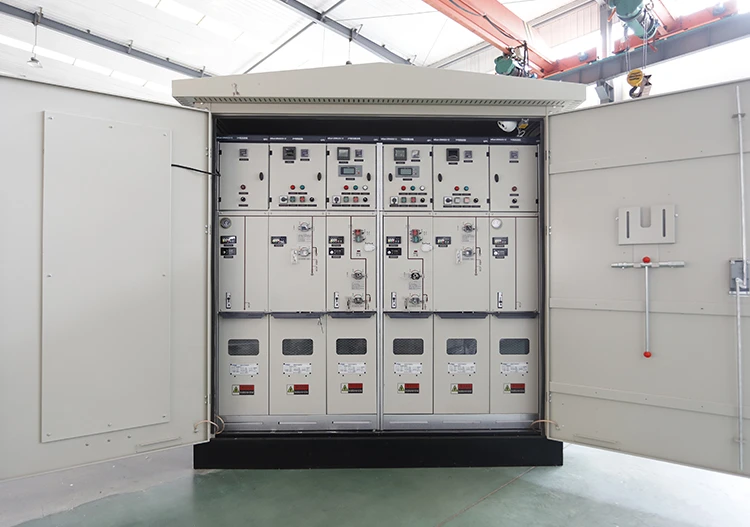

The low-voltage switchgear is the "low-voltage outlet" of the box-type substation, which is responsible for the distribution, control and protection of the low-voltage electrical energy after the transformer is buckled, and it is directly connected to the terminal electrical equipment. Its core role is to distribute 0.4kV of low-voltage electrical energy to different electrical circuits according to user needs, such as lighting circuits, power circuits, fire-fighting circuits, etc., and at the same time monitor and protect each circuit in real time. The low-voltage switchgear is internally equipped with air switches, leakage protectors, contactors and other components. When a circuit has overload, short circuit, leakage and other problems, the power supply of the circuit can be cut off in time to avoid damage to electrical equipment and ensure the safety of personnel.In addition, the low-voltage switchgear also has a metering function, which can accurately count the power consumption of each circuit and provide a basis for power consumption management and billing. Some switchgear can also be remotely controlled to improve operation and maintenance efficiency.
In addition to the above three core components, prefabricated substation also contain auxiliary protection components, such as grounding devices, cooling systems, lightning protection devices, etc., although they are not core but indispensable. The grounding device guarantees the grounding safety of equipment and personnel, the cooling system maintains the temperature stability in the box to avoid damage to components due to overheating, and the lightning protection device prevents lightning impact from damaging the equipment.

In summary, transformers, high-voltage switchgear, and low-voltage switchgear constitute the core architecture of Prefabricated substation. The three have a clear division of labor and operate in concert: the high-voltage switchgear receives high-voltage electrical energy and performs protection and control, the transformer completes the voltage conversion, and the low-voltage switchgear distributes low-voltage electrical energy to end users to jointly realize the safe and efficient transmission and utilization of electrical energy, and support the electricity needs of various scenarios.


